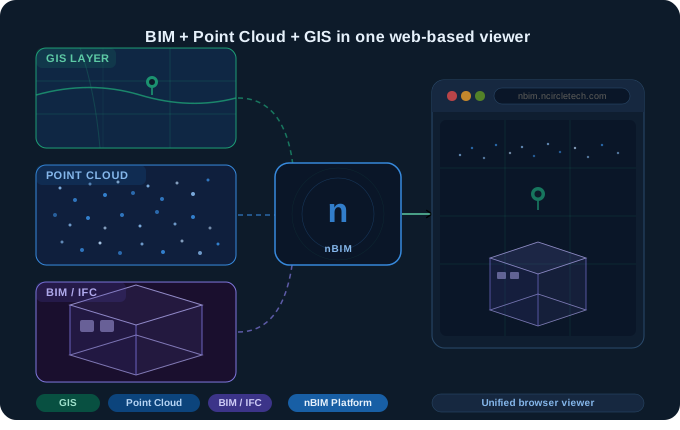
The infrastructure industry stands at a critical inflexion point. Land surveying firms capture precise geographic data. Scanning companies generate extraordinarily detailed point clouds. GIS teams maintain regional and infrastructure spatial records. BIM professionals create richly detailed asset models. Yet, despite these advances, most organizations still manage assets
through disconnected systems—copying data between platforms, manually reconciling spreadsheets, and making decisions based on outdated information.
This fragmentation isn’t a minor inefficiency. It’s a fundamental barrier to modernized asset management.
The transition from purely physical asset management—where records exist on paper, in field notes, and in disconnected databases—to integrated digital asset management represents the next evolutionary step for the AEC industry. And it begins with breaking down data silos through intelligent integration.
nBIM enables this transformation by creating a unified workspace where surveyed land data, scanned reality, geographic context, and detailed BIM models coexist as a coherent, navigable asset ecosystem. This integration doesn’t replace existing tools—it connects them, making your entire data infrastructure work as one.
Understanding the Problem: Why Asset Data Fragmentation Costs You More Than You Realize
The Hidden Economics of Siloed Data
Most infrastructure organizations operate with asset information distributed across 4-6 separate systems:
– Survey data stored in proprietary surveying software or CAD platforms
– Point cloud datasets archived in 3D visualization tools or cloud storage
– GIS records are maintained in geographic information systems, often with outdated references
– BIM models living in design and modeling software
– Facility management data isolated in CMMS or EAM systems
– Regulatory and compliance records scattered across documentation systems
When data lives in separate silos, several costly consequences emerge:
Accuracy Degradation: Every manual transfer between systems introduces potential errors. A surveyor’s precise coordinates get retyped into a GIS system, introducing margin-of-error risks. Point cloud data loses its semantic context when it is moved to a BIM model. That GIS boundary information never reaches the as-built documentation.
Increased Operational Cost: Teams spend 15-40% of their time on data reconciliation—comparing sources, resolving discrepancies, and determining which record is authoritative. This administrative burden diverts resources from higher-value work, such as strategic maintenance planning and infrastructure optimization.
Poor Decision-Making: Asset managers make decisions based on incomplete information. Without access to real-time scan data alongside historical GIS records and design specifications, maintenance decisions become reactive rather than predictive. Utilities fail before anticipated. Renovations begin on inaccurate as-built data.
Compliance and Audit Trail Failures: When asset records are stored across multiple systems with varying update frequencies, maintaining regulatory compliance becomes a daunting task. Auditors struggle to establish a complete chain of custody for asset modifications. Organizations face penalties and extended project timelines.
Project Delays: Stakeholders can’t access a single source of truth. A contractor requires point cloud data for precise dimension verification but finds that it’s stored in a separate archive from the GIS boundary information, resulting in days of searching, downloading, and manual coordination, which leads to delayed decisions.
Research from infrastructure management platforms indicates that organizations lose approximately 30% of their potential operational efficiency due to data fragmentation alone—a loss that compounds over the years of asset lifecycle management.
The Root Cause: Why BIM, GIS, and Point Cloud Data Have Remained Disconnected
Technical Integration Barriers
The reason these data streams remain disconnected isn’t due to a lack of technology. It’s due to fundamental differences in how these systems were initially designed.
Different Coordinate Reference Systems: BIM models typically use project-based coordinate systems, optimized for precision within a specific building footprint. GIS systems operate on global coordinate reference systems (like WGS84 or local projected systems). Point clouds from LiDAR or laser scanning capture data in their own native coordinate spaces. Converting between these systems requires specialized translation—something that most organizations attempt to do manually.
Incompatible Data Formats: BIM software natively exports IFC (Industry Foundation Classes), RVT (Revit proprietary format), or NWC (Navisworks proprietary format). GIS platforms work with shapefiles, GeoJSON, or proprietary geodatabases. Point cloud data arrives in LAS, LAZ, or E57 formats. Each format carries different metadata structures, semantic meanings, and spatial reference definitions.
Semantic Meaning Loss: When point cloud data is introduced into a BIM model, it’s often treated as a visual reference rather than a semantic asset with properties, condition data, and maintenance history. The intelligence embedded in the original scan becomes a dumb 3D visualization. Similarly, when GIS features transition to BIM, their geographic context and spatial relationships are often abandoned.
Organisational Misalignment: Different departments use these systems independently—surveying departments’ own survey software. GIS teams manage geographic databases. BIM coordinators control design platforms. IT infrastructure supports these as separate ecosystems. This departmental fragmentation naturally creates technical silos, as no single department has the mandate or incentive to integrate across systems.
The Workflow Dysfunction
Beyond technical barriers lie workflow dysfunction:
– Surveyors deliver data files; engineers must manually import them into BIM
– Scanning companies provide point clouds; asset teams struggle to extract actionable intelligence
– GIS teams maintain authoritative spatial records; construction teams use outdated reference data
– As-built documentation never updates the original GIS; future projects inherit inaccurate context
Each handoff introduces delay and risk. Each manual data transfer creates opportunities for error.
The Business Case for Integration: What Modern Asset Management Demands
The Rise of Predictive Asset Lifecycle Management
Forward-thinking organizations recognize that the future of asset management isn’t reactive—it’s predictive. Rather than responding to asset failures after they occur, predictive approaches anticipate degradation, schedule maintenance strategically, and extend the lifespan of assets.
This shift is only possible when asset information is:
– Current and Real-Time: Point cloud data captured through regular scanning reflects actual asset condition, not assumptions from years-old designs.
– Contextually Complete: Assets are understood within their geographic and regulatory context (GIS), their structural relationships (BIM), and their current physical state (point clouds).
– Accessible Instantly: Maintenance teams, engineers, and planners can access the data they need within seconds, not hours of searching and downloading.
– Trustworthy and Authoritative: All stakeholders reference the same dataset, eliminating confusion about which record is correct.
Organizations managing critical infrastructure—such as water treatment facilities, electrical distribution networks, transportation systems, and telecommunications infrastructure—are already discovering that integrated asset data unlocks 20-40% improvements in maintenance efficiency and extends asset operational life by 15-25%.
For land surveying firms, scanning companies, and asset management organizations, this shift represents both a challenge and an opportunity. Clients increasingly demand integrated, digital asset records. The organizations that can deliver this seamlessly gain a competitive advantage. Those that continue offering fragmented deliverables will find their value proposition eroding.
Introducing nBIM: The Integration Platform for Physical-to-Digital Asset Management
What Is nBIM? A Unified Asset Intelligence Platform
nBIM isn’t another siloed software tool adding to your technology stack. It’s an integration platform purpose-built to unify BIM, GIS, and point cloud data into a cohesive, navigable asset ecosystem.
Rather than forcing organizations to abandon existing systems and migrate to a proprietary platform, nBIM connects to what you already use:
– Integrates with industry-standard BIM platforms (Revit, Vectorworks, OpenBIM standards)
– Connects to authoritative GIS data sources (ArcGIS, open geospatial standards)
– Ingests point cloud data from any scanning source (LiDAR, terrestrial laser scanning, photogrammetry)
– Works with cloud infrastructure and on-premises deployments
The Core Value Proposition:
nBIM creates a unified workspace where these three essential datasets interact intelligently. Surveyors’ geographic context is automatically incorporated into BIM models. Point cloud scans are semantically enriched with asset properties and maintenance history. GIS records update as BIM models evolve. Asset managers access complete, current information without switching between applications.
How nBIM Integrates These Three Critical Data Streams
1. BIM as Asset Intelligence:
Building Information Modeling provides semantic richness—detailed asset properties, relationships, systems hierarchies, material specifications, and performance parameters. nBIM leverages this intelligence layer as the authoritative asset record, enriching it with geographic and point cloud context.
2. GIS as Spatial Context:
Geographic Information Systems contribute the critical missing layer: spatial relationships, environmental context, regulatory boundaries, and geographic distribution. When integrated with BIM, GIS context transforms individual building models into assets understood within their larger infrastructure ecosystem.
3. Point Cloud Data as Reality Verification:
LiDAR and laser-scanned point clouds capture the actual physical state of assets. When unified with BIM design data and GIS context, point clouds enable:
– As-built verification (does the asset match the design specification?)
– Condition assessment (are there signs of degradation, structural compromise, or wear?)
– Change detection (how has the asset evolved since the last scan?)
– Precision spatial measurement (extracted directly from reality, not assumptions)
By connecting these three essential information layers—asset intelligence (BIM), spatial context (GIS), and physical reality (point clouds)—nBIM creates what infrastructure professionals call a “digital twin”: a comprehensive, continuously updated model that represents both how assets should perform (design intent) and how they actually perform (reality).
The Workflow Transformation in Practice
For Land Surveying Firms:
Traditional survey delivery: Static PDF maps and CAD files.
With nBIM, Survey data becomes part of a living asset record. Boundary information, utility locations, terrain models, and geographic references automatically contextualize BIM models and inform GIS databases. Future projects and maintenance teams’ access to survey data is integrated with all other asset information.
For Scanning and Reality Capture Companies:
Traditional point cloud delivery: Visualization files stored separately, disconnected from design and asset management systems.
With nBIM, Point cloud data becomes actionable intelligence. Scans are automatically classified, georeferenced, linked to BIM assets, and enriched with maintenance and regulatory metadata. Asset managers extract condition data directly from point clouds for predictive maintenance. Design teams verify as-built conditions against specifications. Facility managers access the current reality in the same interface where they manage asset records.
For Asset Management Organisations:
Traditional asset management: Spreadsheets are updated manually, reports are generated from fragmented data sources, and maintenance decisions are based on incomplete information.
With nBIM, A unified dashboard surfaces current asset condition (from point clouds), design specifications (from BIM), location and spatial relationships (from GIS), and maintenance history (from asset databases). Maintenance teams make proactive decisions informed by complete, current information. Compliance and audit reporting become automated and defensible.
The Technical Architecture:How nBIM Actually Works
Data Integration and Semantic Enrichment
nBIM’s architecture rests on three core capabilities:
1. Coordinate System Translation:
nBIM automatically converts between different coordinate reference systems—translating BIM project-local coordinates to global geographic systems (GIS), georeferencing point clouds into proper geographic space, and maintaining spatial accuracy throughout transformations.
This isn’t a simple mathematical conversion. It’s an intelligent coordinate transformation that preserves precision while respecting the intentional reference systems each platform uses.
2. Semantic Data Mapping:
Asset metadata travels across platforms intelligently. An asset property defined in BIM (such as pipe diameter, material specification, and installation date) automatically maps to the corresponding GIS feature attributes and point cloud classification categories.
This mapping isn’t static. It’s configurable, allowing organizations to define how their specific asset types and properties are translated across systems.
3. Real-Time Synchronization:
When survey data updates in GIS, or when BIM models are revised with the latest design changes, or when new point cloud scans are processed, nBIM automatically synchronizes these changes across all connected systems. Asset managers consistently access current information without manual re-importing or redundant data entry.
H3: Cloud-Based Collaboration and Access
Modern asset management demands real-time collaboration across distributed teams. nBIM’s cloud infrastructure enables:
– Remote Access: Survey teams in the field, GIS analysts at central offices, BIM designers in project locations, and facility managers at asset sites all access the same current asset information
– Web Visualization: Stakeholders without specialized software can view and interact with integrated asset models through web browsers
Key Benefits Realized Through nBIM Integration
Operational Efficiency Improvements
Reduced Data Redundancy:
When survey data, GIS records, and BIM models are unified, organizations eliminate duplicate data storage and the administrative burden of keeping multiple copies synchronized. IT infrastructure becomes simpler. Data governance becomes more straightforward. Organizations reduce storage costs while improving data reliability.
Faster Project Delivery:
Architects and engineers no longer spend hours tracking down survey data from surveyors, requesting GIS boundary information from separate teams, or remodelling point cloud scans in BIM software. All necessary information exists in a unified context. Project kickoff accelerates. Design phases compress.
Predictive Maintenance Capabilities:
When asset managers access current point cloud data linked to historical GIS records and design specifications, they shift from reactive “fix-when-broken” maintenance to predictive “address-before-failure” strategies. Asset lifecycles extend by 15-25%. Unexpected failures decrease by 40-60%. Overall maintenance costs decline despite more proactive intervention.
Strategic and Competitive Advantages
Authority as a Digital-First Provider:
For surveying, scanning, and asset management companies, delivering integrated asset intelligence instead of fragmented data files positions your organization as a modern, technology-forward provider. Clients are increasingly demanding this integration—organizations that provide it become preferred partners.
Scalable Asset Intelligence:
Rather than managing individual buildings or properties as isolated records, organizations can manage thousands of assets as a cohesive, understood portfolio. Regulatory compliance becomes systematic. Asset renewal planning becomes data-driven.
Regulatory Compliance and Auditability:
Integrated asset records create defensible audit trails. When regulators demand proof of maintenance, compliance monitoring, or asset condition, organizations can instantly produce complete documentation—no more searching across systems or reconstructing history from fragmented records.
Industry Applications and Use Cases
Water and Wastewater Infrastructure Management
Water utilities manage thousands of kilometres of pipes, pumps, treatment facilities, and distribution networks. Accurate knowledge of infrastructure location (GIS), design specifications (BIM), and current condition (point cloud scans from internal inspections) is critical for maintenance planning.
Organizations using nBIM can identify ageing pipe sections before they fail, plan strategic replacement programs with confidence, and respond to emergencies with complete asset information. Pipe break rates decrease—unplanned repairs decline. Water loss from ageing infrastructure has reduced.
Smart City and Transportation Infrastructure
Cities that manage roads, bridges, traffic signals, and public utilities benefit significantly from integrated asset management. nBIM enables cities to maintain authoritative asset records across thousands of features, correlate maintenance data with GIS-referenced locations, and make infrastructure investment decisions based on comprehensive condition assessments.
Real transportation example: A city scans its bridge portfolio with LiDAR, generating point clouds. Traditional workflows would treat these scans as separate files. With nBIM, scans are automatically integrated with BIM bridge design models and GIS records, enabling engineers to assess structural condition against design specifications and geographic context simultaneously.
Renewable Energy Asset Management
Wind and solar farm operators manage geographically distributed infrastructure with complex maintenance requirements. nBIM integrates the geographic distribution (GIS), design specifications (BIM), and regular condition monitoring through point clouds (from drone surveys or inspection scans).
Energy operators achieve 20-30% improvements in maintenance scheduling efficiency, reduce unplanned downtime, and extend the operational life of assets through data-driven maintenance decisions.
Archaeological and Cultural Heritage Documentation
Heritage organizations use integrated BIM, GIS, and point cloud data to create comprehensive digital records of historic sites. This documentation serves both preservation and research purposes—creating reference records for future generations while enabling detailed conservation planning today.
Implementation Considerations: Getting Started with nBIM
Data Preparation and Assessment
Audit Current Data:
Begin by assessing your existing GIS, BIM, and point cloud datasets. Understanding data quality, completeness, and current coordinate systems informs implementation strategy.
Define Asset Classification:
Determine which assets should be integrated into nBIM. Not every asset may justify immediate integration. Strategic prioritization accelerates value realization—focusing first on the highest-value assets or most critical systems.
Establish Data Governance:
Define who is responsible for managing asset updates in each system. Establish clear workflows for when data changes in BIM, GIS, or point cloud sources. Poor data governance creates confusion about which record is authoritative.
Team Preparation and Training
Successful nBIM implementation requires cross-functional engagement:
– GIS teams must understand how geographic data integrates with BIM models
– BIM coordinators need to learn how point cloud data enriches design information
– Facility managers require training on accessing and leveraging integrated asset records
– Executives must understand strategic value and ROI implications
Organizations that invest in comprehensive training see 3-5x faster adoption and value realization.
Phased Rollout Strategy
Rather than attempting organization-wide integration simultaneously, consider phased approaches:
1. Pilot Phase: Select a defined geographic area, facility, or asset type. Implement nBIM with a core team. Demonstrate value and refine processes.
2. Expansion Phase: Extend to additional facilities or asset types, leveraging lessons learned from pilot.
3. Scaling Phase: Integrate remaining assets and workflows across the organization.
Phased approaches reduce risk, accelerate learning, and build internal support for the transformation.
Frequently Asked Questions
Q: Can nBIM handle real-time point cloud streaming from continuous monitoring?
A: Yes. nBIM can integrate continuous monitoring data, enabling real-time tracking of asset conditions. This capability allows for predictive maintenance approaches, where systems alert teams to emerging issues before they escalate into failures.
Q: How does nBIM maintain data security and compliance?
A: nBIM implements enterprise-grade security, including encryption, access controls, audit logging, and compliance support for regulations like GDPR and industry-specific standards. Organizations maintain complete control over data storage locations and can choose between cloud and on-premises deployment options.
Q: Is nBIM suitable for small organizations or only enterprise-level companies?
A: nBIM serves organizations of all sizes. Small surveying firms use nBIM to deliver enhanced value to clients. Mid-sized asset management companies leverage nBIM to gain a competitive advantage. Enterprise organizations use nBIM to manage thousands of assets at scale. The implementation scope adjusts to an organization’s size and needs.
Q: How does nBIM handle different coordinate systems across projects?
A: nBIM automatically manages coordinate system translations and transformations, preserving accuracy while converting between project-local, regional, and global reference systems. This happens automatically behind the scenes—users don’t need to perform coordinate transformations manually.